
Cyclic Load Testing of Curtain Walling Panels
Project Aim
To evaluate the performance of mineral fibre core materials used in Composite structural panels for architectural applications.

Introduction
Currently there are no national or industry standards designed to specifically test the long term durability of composite sandwich panels: The commonly used test “CWCT Wind Resistance – Serviceability” only involves 7 pressure pulses each in the positive and negative directions.
To test the long-term performance, and to determine if there is any performance degradation over time, a test involving a significant number of load cycles was developed.
Methodology
A test jig was produced using standard (commercially available) curtain walling frame supplied by Senior Architectural Systems Ltd. This frame was rigidly mounted onto a high stiffness composite panel to minimise frame flexing and to provide a cavity in which the air pressure could be varied.
Figure 1: Simplified CAD model of frame with panel
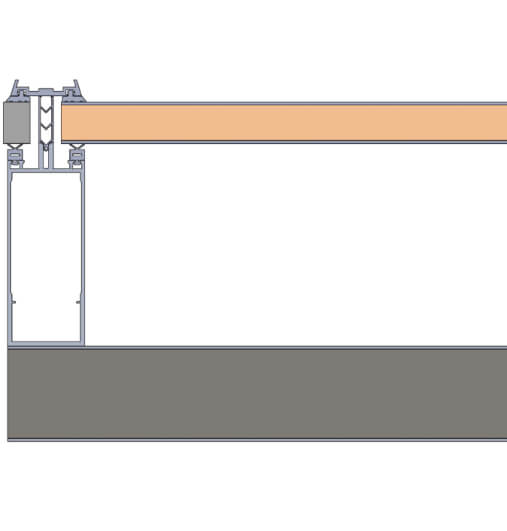
Figure 2: Cross section showing panel, frame, spacer, and stiffening panel
A high-pressure blower and valve combination was used to control the pressure in the void behind the panel, this applied the positive and negative force to the panel. To determine long-term performance the pressure was cycled every 3 seconds.
A datalogger along with a pair of pressure sensors were used to check the pressure applied to the panel and to measure the number of pressure cycles. To accurately capture the minimum and maximum pressures, the datalogger was set to take 14 measurements per second.
The test panel was 28mm thick, consisting of 1.5mm aluminium faces either side of a 25mm Nexus Mineral Fibre core. Panel size was 1200mm x 1200mm. The panels were vacuumed bonded using a 2-part moisture curing polyurethane adhesive. Thirty-two measurement locations were marked around the perimeter of the panel. The panel thickness was measured using digital callipers 10mm from the edge at each location.
The panel being tested was installed following the frame system manufacturer’s instructions, including installation of fasteners to the specified torque, ensuring the correct preload was applied.
The panel was subjected to a 2-stage testing regime with a different range of positive and negative pressure.
Results
In total the panel was subjected to 210,000 cycles and the results are detailed as follows:
| Applied Pressure | Number of cycles | Edge Thickness | |
|---|---|---|---|
| Pre test | N/A | N/A | 27.74mm |
| Stage-1 | -0.9kPa to 1.3kPa | 100,968 | 27.49mm |
| Stage-2 | -1.2kPa to 1.6kPa | 109,725 | 27.52mm |
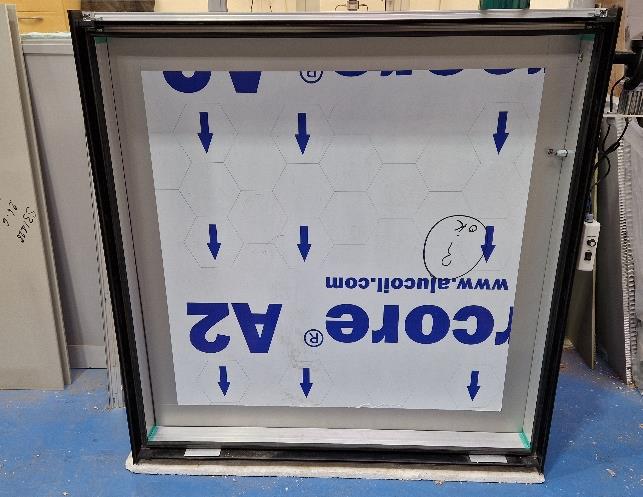
Figure 3 – Test frame without panel
In Stage-1 the edge thickness was found to have reduced by an average of 0.25mm compared to the pre-test state. In Stage-2 there was no significant change in the edge thickness. The change of 0.03mm is less than the expected measurement error.
Additional measurements taken 40mm in from the edge of the panel showed a change of 0.02mm over the full test. This shows that the change in thickness observed, is only present at the edge of the panel.
Conclusion
The reduction in thickness prior to the test would be accommodated by the gaskets used in the curtain walling system. The results confirm that for the panel specification and size detailed there are no concerns regarding compression of the panel edge due to cyclic wind loads.
Contact us
Get in touch to find out more about pricing, or to discuss your requirements in more detail.
Please note: We specialise in supplying commercial manufacturers and trade customers. Unfortunately, we are unable to quote for most individual self-build camper van or motorhome projects.
Call us on 0114 249 5626